

Abandoned cart email marketing: examples and sequence
Someone put the product in the basket and left. You haven't lost them — not yet. A simple email sequence can bring some of those orders back.
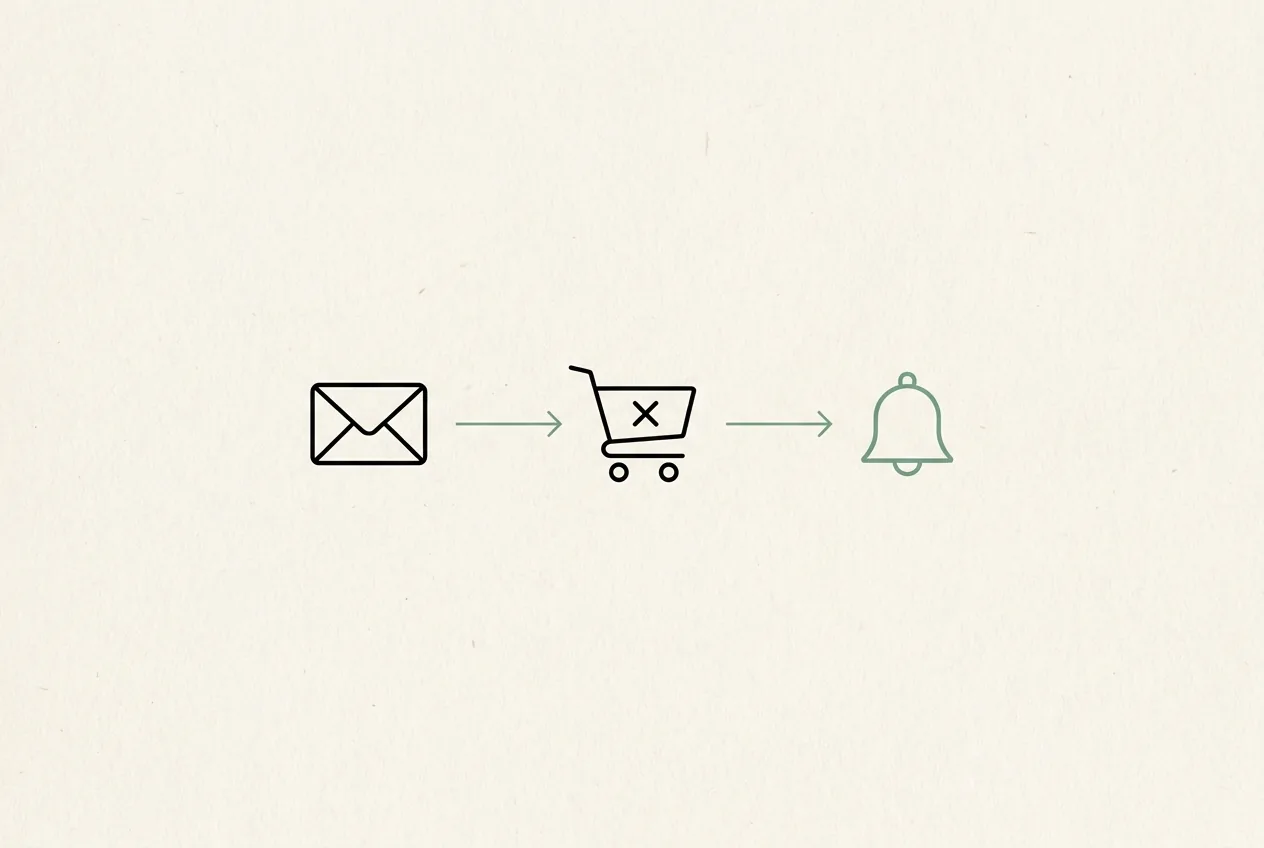
“People add things to the basket and leave. How do I get them back?”
The good news: someone who has gone as far as putting the product in their basket is the warmest lead you have. They wanted the product. They were one step away. Unlike someone who has only just discovered you, this person already knows you and already wanted you.
And an abandoned cart is normal — a good chunk of people change their mind, get distracted, want to compare. Your job isn’t to eliminate abandonment (impossible), it’s to recover a slice of it. With a simple email sequence.
📌 What you’ll learn: why people abandon their cart, the structure of a recovery sequence, concrete email examples and what NOT to do.
🤷 Why people abandon their cart
Before you write a single email, understand why they leave. The most common reasons:
- Surprise costs at the end — shipping or fees that only appear at checkout.
- They were just comparing — they wanted to see the total price, with no intention of buying right now.
- Clunky checkout — too many steps, a mandatory account, long forms.
- Distraction — the phone rings, the baby cries, they close the tab and forget.
- Hesitation — they’re not sure about returns, sizing or quality.
The recovery email won’t solve all of these (a poor checkout is something you fix on the site, not through email). But for those who got distracted or are hesitating, a well-crafted reminder can close the sale.
📧 The structure of a recovery sequence
Don’t send a single email. And don’t send ten. A staggered sequence of 3 emails covers it well:
| When | Its role | |
|---|---|---|
| 1 | After ~1 hour | Friendly reminder — “you’ve left something in your basket” |
| 2 | After ~24 hours | Remove an objection — trust, returns, questions |
| 3 | After ~2-3 days | Final reminder, perhaps a small incentive |
The logic: the first catches the distracted shopper while they’re still warm, the second answers the hesitation, the third is the last hand you reach out before you close the door.
An incentive (a small discount, free shipping) is best saved for the last email, not thrown in from the first. Otherwise you teach your customers to abandon the cart just to get a discount.
✍️ Concrete email examples
Below are illustrative examples — adapt them to your brand’s voice. They’re starting points, not templates to copy blindly.
Email 1 — The reminder (after ~1 hour)
Subject: You've left something in your basket 🛒

Hi [Name],

You left [Product] in your basket. We've kept it for you — it's still here,
ready to order.

[Product image + button: Continue your order]

If you've changed your mind, no problem at all. If not, we'll take you straight
to the last step — it only takes a minute.

[Button: Complete your order]
Short, friendly, no pressure. Just open the door again.
Email 2 — Remove the objection (after ~24 hours)
Subject: A question about [Product]?

Hi [Name],

I see [Product] is still waiting for you in your basket. If you hesitated, it
might help to know that:

- Returns are simple — you have [X] days to change your mind.
- Delivery takes [timeframe].
- We're here if you have questions — just reply to this email.

[Button: Resume your order]

We're happy to help if anything isn't clear.
Here you tackle the fear, you don’t just reheat the reminder. Trust is what’s often missing.
Email 3 — The last hand (after ~2-3 days)
Subject: Last chance for [Product]

Hi [Name],

We're still holding [Product] in your basket for you, but not for long.

To make it easier to decide, we're offering you [free shipping /
a small discount] on this order.

[Button: Complete it now]

After this, we'll clear the basket — but the product stays in the shop anytime.
The incentive only appears here, as a final argument. The tone stays calm, not desperate.
🚫 What NOT to do
1. Don’t send 6 emails. After 3, you become spam. Respect the person’s decision not to buy.
2. Don’t put a discount in the first email. You train your customers to abandon just to get a discount. Save it for the end, if you use it at all.
3. Don’t sound desperate. “LAST CHANCE!!! HURRY!!!” scares people, it doesn’t convince them. Keep the tone calm and helpful.
4. Don’t fix a poor checkout through email. If most people abandon because of a clunky checkout or surprise costs, you fix it THERE. The email recovers a slice, it doesn’t fix the structure.
5. Don’t forget mobile. Most people read email on their phone. If the button isn’t visible or the page is slow on mobile, you’ve lost the person a second time.
🛠️ Where it’s built
On Shopify, these sequences can be set up as automated flows — they trigger on their own when someone abandons their cart, without you sending anything manually. You set up the logic once (who, when, what they receive) and it runs in the background.
Important: the tool isn’t the magic. The magic is the right message, at the right time, to the right person. The technology just delivers it.
In short
An abandoned cart is normal, and those who abandon are the warmest customers you have. A sequence of 3 emails — reminder, objection removal, last hand — recovers a slice of the lost orders. A calm tone, no desperation, the incentive saved for the end, and a checkout fixed on the site rather than patched up through email.
If people often reach the basket but don’t complete the purchase, the problem may be higher up the funnel. It’s worth also looking at why you have traffic but aren’t selling — cart recovery is the last link, not the first.
We build automated Shopify flows on our Shopify development page.
If you’d like us to set up a cart recovery sequence for you — automated, in your brand’s voice, connected to your shop — we can take a look at what you’ve got and tell you what’s worth doing first.
Read on
All articles →
Let's audit your account. Free.
We'll tell you straight what we'd change first and what scaling potential we see.