

How to calculate CAC and LTV (and why the ratio between them matters)
CAC tells you how much you pay for a customer. LTV tells you how much they're worth. The ratio between them decides whether you can grow or whether you're burning money.
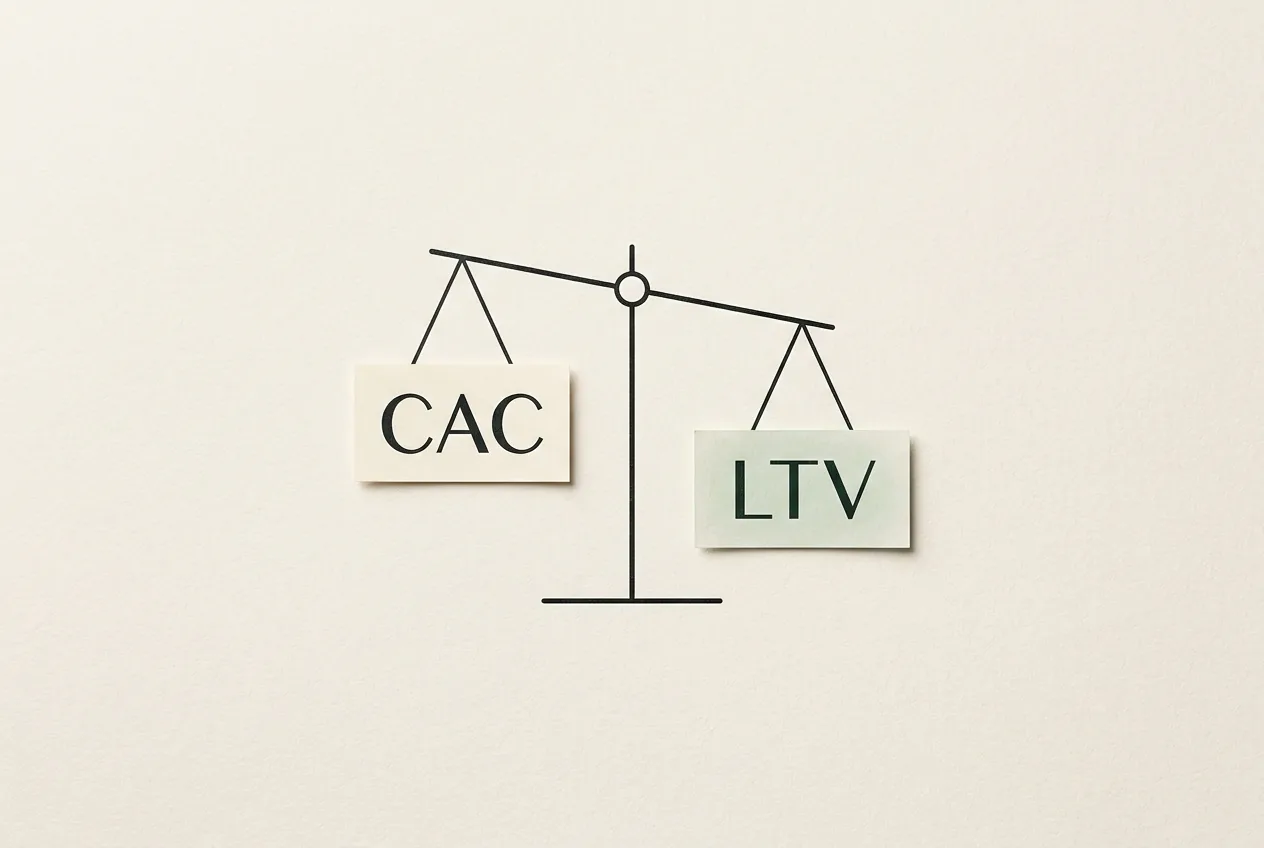
“How much can I spend to bring in a new customer?”
If you can’t answer that question, you don’t actually know whether you’re making or losing money on ads. And plenty of people don’t know — they look at ROAS, see a number, but never connect how much a customer costs with how much they’re worth over time.
Two figures solve this: CAC and LTV. Let’s work out both, simply, and see why the ratio between them matters more than either one on its own.
📌 What you’ll learn: How to calculate CAC, how to calculate LTV, what the LTV:CAC ratio means, and which values point to a healthy business versus one that’s burning money.
💸 CAC — how much a new customer costs you
CAC = Customer Acquisition Cost. How much you spend, on average, to bring in a new customer.
The formula:
CAC = Total marketing spend / Number of NEW customersA hypothetical worked example:
Marketing spend this month:  10,000 lei
New customers acquired:      100
CAC = 10,000 / 100 = 100 lei/customer
So it cost you 100 lei to bring in each new customer.
Two common pitfalls with CAC:
- Include ALL acquisition costs, not just the ad budget. If you pay for a tool, a freelancer, a commission — it goes into the calculation.
- Count NEW customers, not total orders. If those 100 orders include returning customers, your real CAC is something else.
💎 LTV — how much a customer is worth over time
LTV = Lifetime Value. How much revenue (or profit) a customer brings you for as long as they keep buying from you. Not just on the first order — across the whole relationship.
This is the key thing many people miss: they only look at the first sale. But a good customer buys more than once.
The simple formula:
LTV = Average order value × Orders per year × How many years they stay a customerA hypothetical worked example:
Average order value:    200 lei
Orders per year:        3
Length of relationship: 2 years
LTV = 200 × 3 × 2 = 1,200 lei
So a customer brings you, on average, 1,200 lei in revenue over the whole period.
Note: if you want to compare it properly with CAC (which is a cost), it’s more honest to use LTV on profit, not on revenue. That is, take the margin, not the total. With gross revenue, the ratio comes out nice but misleading.
LTV on profit, for the same example, if your margin is 40%:
LTV (revenue):  1,200 lei
× 40% margin
LTV (profit):   480 lei
⚖️ The LTV:CAC ratio — the figure that decides everything
On its own, CAC tells you nothing. Is “100 lei per customer” a lot or a little? It depends on how much the customer is worth. That’s why you put them together.
Ratio = LTV / CACUsing the examples above (LTV on profit 480 lei, CAC 100 lei):
Ratio = 480 / 100 = 4.8So for every leu spent on acquisition, you recover 4.8 lei in profit over the life of the relationship. That’s healthy.
How to read the ratio:
| LTV:CAC ratio | What it means |
|---|---|
| below 1 | You lose money on every customer. Stop. |
| 1 – 3 | Fragile. You recover it, but the margin for error is small. |
| 3 – 5 | Healthy. This is where you want to be. |
| above 5 | Very profitable — but you may have room to invest MORE in growth. |
The surprise for many: a ratio that’s too high isn’t necessarily something to be proud of. If you recover 8 times your investment, you might be too timid with the budget and leaving growth on the table.
⏱️ And there’s one more question: how fast do you get your money back?
Two businesses can have the same LTV:CAC ratio and yet one is in danger. Why? Cash flow.
If you pay 100 lei today for a customer, but the 480 lei of profit comes spread over 2 years, you’ve spent the money now and recover it slowly. That can choke you if you scale fast.
That’s why you also track payback: how many months it takes to recover the CAC. The faster, the freer you are to reinvest.
🛠️ How to use them together, in practice
- Work out your real CAC, with all costs, on new customers.
- Work out LTV on profit, not on revenue, so it’s comparable.
- Divide them. If the ratio is below 3, you have a profitability problem, not a traffic problem.
- Track payback. A good ratio with slow recovery can still block your growth.
- Recheck often. Ad costs and customer behaviour change; CAC and LTV aren’t figures you calculate once and you’re done.
In short
CAC = how much you pay for a customer. LTV = how much they bring you. The LTV:CAC ratio tells you whether your business can grow healthily or burn money. Aim for a ratio between 3 and 5, calculate LTV on profit (not on revenue), and track how fast you recover your investment.
CAC and LTV go hand in hand with ROAS. ROAS looks at a single transaction; LTV:CAC looks at the whole customer. If you’re not confident on ROAS, start with what ROAS is and how to calculate it. And if you’re bringing in customers but they don’t turn into orders, the problem is further down — see why you have traffic but aren’t selling.
If you’d like us to put these numbers together for your shop — real CAC, LTV on profit, the ratio between them and how much you can actually spend on a customer — we can take a look together. Your arithmetic, not generic formulas.
Read on
All articles →
Let's audit your account. Free.
We'll tell you straight what we'd change first and what scaling potential we see.