

Full-funnel marketing strategyYour store, ads and emails, with one team, depending on the services you choose.
One system, from the person who sees the product for the first time to the customer who returns and brings you their friends. So that nothing gets lost between your store, ads and emails.
What a marketing funnel is and how we build it
Each channel brings people to a different floor of the funnel. The numbers are an example from our guide, not a promise.

An illustrative example, to show the path: not data from a client, not an average and not a promise. Percentages differ from store to store.
A marketing plan for your online store
A customer does not go from "I don't know you" to "I'll buy" from a single ad. Each floor prepares them for the next.
 Floor 1
Attract
Facebook and Instagram bring in the curious, Google brings in people interested in the product.
We track: how many new people reach us and what it costs. Floor 2
Keep them close
Anyone who saw the ad or visited the site sees the products again, and emails remind them.
We track: how many add to cart. Floor 3
They buy
We catch the demand that already exists and close the sale: search, Shopping and a store that convinces.
We track: what each €1 brings in and what a customer costs. Floor 4
They return
Happy customers can come back and bring others: automated emails, reviews, the second-order offer.
We track: how many return and how much they buy in total.And then it keeps turning: happy customers can bring others, and each turn can bring new customers more cheaply.
The sales funnel across Meta, Google and TikTok
Each tool has its role. We make them work together, not fight each other.
Shopify: the shop
- A fast, secure store, always open.
- The catalogue feeds ads with products on Facebook, Instagram and Google.
- Automated emails, reviews and discounts, from the same place.
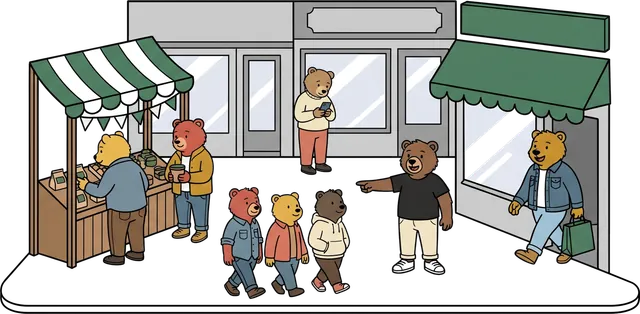
Facebook and Instagram: the fair stall
- New audiences, with lookalikes of your buyers.
- Retargeting with exactly the products viewed, from the catalogue.
- Reels, Stories and short video that doesn't look like an ad.
Google and YouTube: the shop-window street
- Search and Shopping for people already looking.
- Retargeting on YouTube and on partner sites.
- Performance Max, across all Google placements.
Do you have video clips that you or your creators film? TikTok is added as a fourth channel: you bring the clips, we give the brief and keep what sells. See TikTok Ads →
Who we target: closer and closer
We do not show everyone the same message. The closer someone is to buying, the more direct the message.
- Cold They don't know you yet: people chosen by interests and lookalike audiences of your buyers. They see: a video that stops the scroll.
- Warm They have seen you: they watched a video, liked it or visited the site in the last month. They see: the products, with reviews.
- Hot They added to cart or started checkout, but didn't finish. They see: exactly the product in their cart, by email and in ads.
- Customers They have already bought. We take them out of the ads for new people. They get: a thank-you, a review request and the second-order offer.
What someone sees after they visited and left
Step by step, on the right channel. An example.
It all ties together only if measurement is correct. The visit, the cart, the payment and the purchase go from the store to Facebook and Google. Without them, retargeting does not know who to catch.
Emails that send themselves
Automations from Shopify. They send themselves, only to people who opted in, and they have one job: to bring people back for the second order.

~70% of online carts are abandoned before purchase (Baymard Institute, average of 50 studies from 2006–2025, accessed 09.11.2026). An abandoned-cart email can recover some of them.
Marketing emails go only to people who have opted in, and each message has an unsubscribe link. Your store is the data controller, and we set up the sending as processors.
How we split the ad budget
It depends on what you want now: to grow or to make a profit. Pick one, and the budget splits differently.

The starting point from our guide: you feed the top of the funnel without leaving the rest uncovered.
Emails are not part of the ad budget; they are calculated separately. An example, not a recommendation. With a small budget we don't split across all the floors: we start with one channel. The proportions are starting points, not rules: we set them at the audit and shift them once the numbers show.
The whole system, turnkey
The accounts, the pixel, the catalogue and the data stay yours.

When we DON'T suggest full funnel
- The budget barely covers one channel: we start with the one that hurts most and expand when the numbers support it.
- The pain is clearly in one channel: we don't inflate the offer.
- Your site doesn't sell: the store comes first. Otherwise you lose money on two channels instead of one.
It's not a bundle of services, it's one system: Facebook ads can lift searches for your brand name, which Google then collects, and emails can bring people back for the second order.
What you want to know first.
Why both? Let's start with one.
If the budget supports both, separating them can cost you: demand created on Facebook can be captured by a competitor on Google. If it doesn't, we'll tell you to start with one.
That's too much at once.
They do not start at the same time: first the main channel and measurement, then the second, each with your approval. "Full" is the destination, not day one.
How do I know what each channel brings me?
You get a single report, with the same measurement across all channels. Platform numbers overlap, so we agree together how to attribute the sale to each channel.
I'd be putting all my eggs in one basket.
The accounts, pixels, catalogue and data stay yours. You can end the collaboration with 7 days’ notice, written into the contract, and you leave with the accounts, the pixel, the catalogue, the audiences, the campaigns and the data in them.
What minimum ad budget do I need?
It depends on the niche and margin. We start from a test budget that gathers data in 2–4 weeks, and at the audit we tell you a realistic threshold, without pushing you to burn money. If it isn't enough for two channels, we start with one.
How soon do I see results?
The first signals usually appear in 2–3 weeks, but a stable result is built over 60–90 days, as the algorithms learn and we test. Performance marketing is a system, not a magic button. We do not guarantee a specific result.
Which channel should I start with: Meta, Google or TikTok?
We start with the channel that hurts most: usually Google, if people already search for you, or Facebook and Instagram, if the product needs to be shown. TikTok is added once you have clips. We decide based on niche, margin and where your customers are, not on what's trendy.
How do you measure after iOS 14 and cookies?
Alongside the pixel, we send events directly from the server as well (Conversions API), plus GA4. That way we recover some of the data the classic pixel loses, and optimisations run on more complete data.
Do you also make the videos and images for ads?
For Facebook, Instagram and Google, yes, as a separate service with its own quote: concepts, scripts, video and static, plus iterating on what works. For TikTok, you bring the clips: we give you the brief, test them and keep what sells.
Do I have to be on Shopify?
Not necessarily, but Shopify makes tracking, the product catalogue and audiences easier for us. We work on other platforms too, and if you want, we will build your store as well.
How do I pay: a fixed fee or a percentage of the budget?
We don't put prices on the page, because they depend on how many channels we start and on the budget. At the audit you get the proposal in writing, before anything starts.
Who keeps the ad accounts?
You do. We work inside your Business Manager and your accounts, with the access we need. The account, the pixel, the catalogue and the data stay yours.
Where does the customer's journey break?
Tick what you recognise, then pick a time to talk. We look at the whole system together.

We piece together what each one does and what gets lost between them.
We tie sales to channels, in a single report.
We see how many people leave the site and how you bring them back.
We check which automated emails you are missing and which to tackle first.
We look at how many return and what you send them after the first order.
We look at everyone’s numbers side by side, to see where the problem is.
Tick what you recognise and we'll tell you on the spot what we check.
We use your name, email and phone number to schedule and hold the free audit (Art. 6(1)(b) GDPR, at your request). Details and your rights: Privacy Policy. We keep them for 3 years from the last interaction.